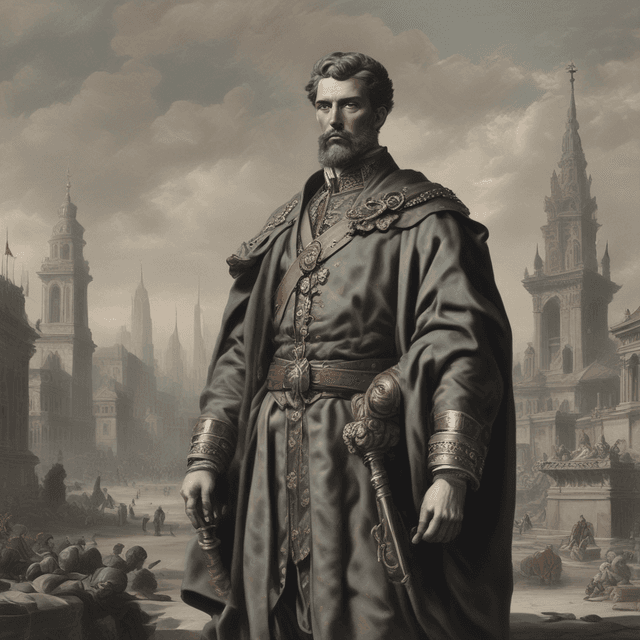
| Name | King Minos |
| Reign | 2nd millennium BCE |
| Domain | |
| Downfall | The collapse of his empire after a massive volcanic eruption on the island of Thera devastated Crete's naval power and economy |
| Known for | Establishing a maritime empire through military conquests • Demanding human sacrifices from subject states • Imprisoning enemies in a complex underground labyrinth |
King Minos was a ruler of the island of Crete in the 2nd millennium BCE, whose legacy as a ruthless and expansionist monarch has cast a long shadow over the ancient Mediterranean world. Contrary to the mythological depictions of Minos as a legendary or quasi-divine figure, historical evidence indicates he was a real historical king who built an extensive maritime empire through military conquest and political maneuvering.
Minos ascended to the Cretan throne around 1700 BCE, consolidating control over the island's diverse principalities and establishing a centralized administration based in the capital of Knossos. Drawing on Crete's strategic location and naval resources, Minos quickly set about expanding Cretan influence throughout the Aegean, engaging in a series of military campaigns against mainland Greece and its island city-states.
Through a combination of alliances, economic coercion, and outright conquest, Minos succeeded in making Crete the dominant power in the region, controlling maritime trade routes and extracting tribute from subject populations. He is believed to have modeled his administration on the highly structured bureaucracy and military hierarchy of the Minoan civilization, which had previously flourished on Crete.
Minos' ruthless ambition and cruelty are perhaps best exemplified by the legends surrounding the Minotaur - a monstrous half-human, half-bull creature said to inhabit a sprawling underground labyrinth beneath Knossos. According to sources, Minos demanded that Athens and other conquered city-states pay a periodic "tribute" of young men and women to be sacrificed to the Minotaur.
While the mythic details have been exaggerated over time, historical evidence suggests there was some truth behind the legend. Archaeologists have uncovered an extensive network of tunnels and chambers beneath Knossos which may have served as a combination prison, execution chamber, and torture facility for Minos' political enemies and captives. The bones of sacrifice victims have even been discovered in certain chambers.
Minos' expansionist empire began to collapse after a massive volcanic eruption on the nearby island of Thera around 1600 BCE, which devastated Crete's naval forces and economic infrastructure. With the loss of maritime power and trade revenue, Minos struggled to maintain control over his subject territories, leading to a series of rebellions and the eventual downfall of the Cretan thalassocracy.
While the Minotaur myth has endured as a symbol of Minos' tyranny, his historical legacy remains a subject of debate and reinterpretation. Some modern historians have reevaluated Minos as a shrewd, if ruthless, political leader who helped lay the foundations for the development of classical Greek civilization. However, his reputation as a cruel despot who demanded human sacrifices and imprisoned opponents in a labyrinth of horrors continues to overshadow any potential positive achievements.
Ultimately, the figure of King Minos stands as a cautionary tale of the dangers of unchecked ambition and the abuse of power. His reign provides a window into the complex political dynamics of the ancient Mediterranean world, and the lingering myth of the Minotaur remains a potent symbol of the human capacity for monstrosity in the pursuit of domination.
